Category Archives: Interdependence

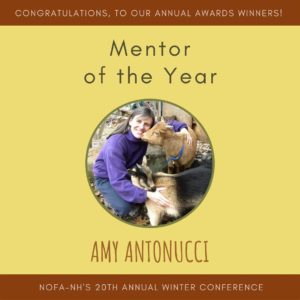
NOFA-NH’s Mentor of the Year

I was touched to receive the 2022 Mentor of the Year Award from The Northeast Organic Farming Association of NH at the winter conference in February.


Growing Soil

In 2017 I was given the Leading Organic Gardener of the Year award, also a huge surprise and honor. I work very hard in my garden, physically and as a constant learner. The inches of healthy soil I’ve helped to grow are part of the legacy I will leave behind when I die. Growing our food here in a sustainable way is also an aspect of how I live in the world in a responsible and giving way: problems such as chemical contamination, food miles, and soil loss are avoided in what I grow here.

So, I will always be proud of being named Leading Organic Gardener of the Year. I think, though, that I am even more pleased by being recognized as a mentor.

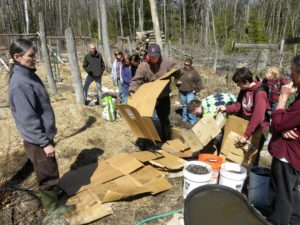
Leading a Sheet Mulching Class

It wasn’t long into my time working on a farm that I realized how much I wanted to empower others to grow, too. I loved the work and knowing that what I did was good and useful to my community. However, I was even more excited to hear from people about their attempts to do it for themselves.

I came to farming after getting a degree in Women’s Studies at UNH-Durham where I learned to see a larger picture of the world and how things are connected and influence each other. I became an activist for women’s rights, peace and environmental health where I further saw the power of working together collectively.

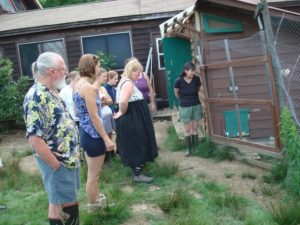
Talking Chickens With Folks

I was thus less interested in growing for people than growing with them, and building a movement of human beings who see that they depend on the land around them for nourishment and life.

As I write this, one of my favorite songs by Sweet Honey in the Rock is “Ella’s Song” comes to mind.  It includes this stanza:

That which touches me most is that I had a chance to work with people,
Passing on to others that which was passed on to me.”

So much of my learning about permaculture and food growing happened at NOFA conferences and classes. I am happy to continue to pass that on and moved that my work has been seen.

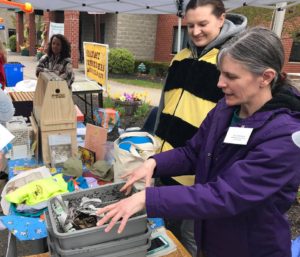
Tabling with my traveling worm bin and beekeeping supplies at a local event

Leave a Comment

Filed under Gardens, Interdependence, Uncategorized

Harvest In Charge

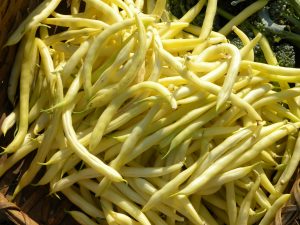
Gold Rush Beans

There is food to pick here as early as April, but true harvest season kicks in as August approaches. Our goal is to not only grow for eating in the summer, but to provide for ourselves year-round. That’s a lot of food for us to bring in and preserve in a short window of time. Thus, in August and September our harvest is my biggest focus – in fact, it really takes over my life! I have learned to plan for it, to free up much of my schedule otherwise and to let people in my life know that emails, calls and letters are not likely to be answered this time of year. I can chart out approximately when I’ll need to do what, but every season has variations so I have to be flexible and willing to change directions. It’s a good but uncomfortable exercise for a person who really likes to follow her list.

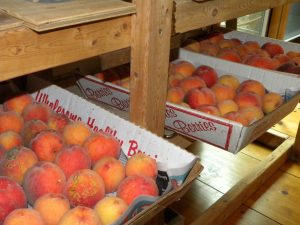
Peaches Waiting to be Canned

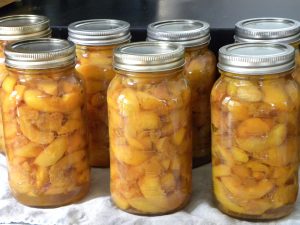
Peaches are particularly demanding – when they are ready, I preserve them or lose them. With the great success of that crop for us this year, days

I canned 89 quarts of peaches this August, all from our own trees!

that I had planned to work on other projects turned into peach canning days. The peaches were simply in charge!


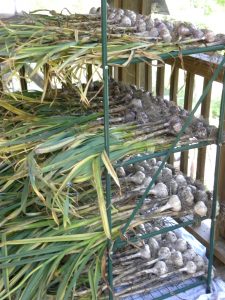
Some of our other big production crops aren’t quite so picky, they will give me days or even weeks of leeway. But being responsive has rewards. Pulling the garlic when the third leaf of the plant dies back, gives the bulbs the best storage life. I’ll still get great garlic after the fourth or fifth leaf withers, but it likely will not last as long. The root crops can sit in the ground until I’m ready to eat them or put them in the root cellar, but the voles will get a bigger and bigger

The garlic is pulled and put out to dry at the end of July.

share as time moves on. The winter squash in the field next to their dying vines are exposed for other critters to gnaw on, too. Our corn is a storage not fresh eating variety so is fine with a long season out there, but we have competition for them as well.


It’s true for our animals, too. Our heritage breed chickens take four months to reach their full size. By then, not only are they taking up space and food without gaining weight, but the roosters have been crowing loudly for about a month and it isn’t long until they will start fighting each other. They have many ways of telling us this is no longer a sustainable, safe situation.

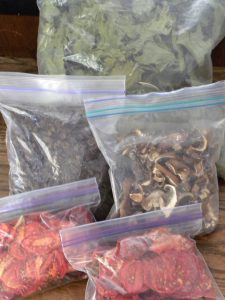
Dehydrated kale, mushrooms, tomatoes and raisins can last for years.

All of our charges – plants, animals, bees – have their own schedule and their own plans. For best results, we learn their rhythms and work to fit ourselves into their calendar, although of course our management decisions are important, too. This is all good practice for remembering our interconnected, cooperative place in the world and re-learning how humans are not in charge but are part of a complex, ongoing dance. Which brings me to a last, philosophical thought for this blog entry…

Just recently I learned, to my great surprise, that when Charles Darwin talked about “survival of the fittest” he meant that those best adjusted to and able to fit in to their environment were the ones that succeeded. His ideas and work were misinterpreted and co-opted to justify competitive, dominant and bullying behavior. In fact, the evidence that cooperation, compassion and flexibility are much more prevalent and useful tactics has become overwhelming.

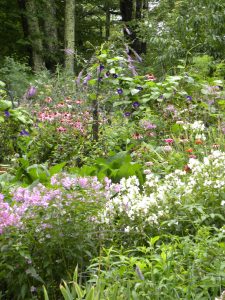
Diversity Supports Health

By the way, he did not say that “fitting in” meant becoming like everything else – in fact, it is through diversification and specialization that competition is often avoided and much energy is saved.

All of this really blew my mind as it is so far from what I was taught earlier in my life. Exploring these ideas over the past few years has reshaped my view of the world, freeing and inspiring me. Permaculture has been a part of this journey with our principles of valuing diversity (#10), embracing relationship and cooperation (#7 & 8) and being willing to learn and change (#1, 4 & 12). I value these opportunities to see and practice such skills – even if they’re currently tiring me out!

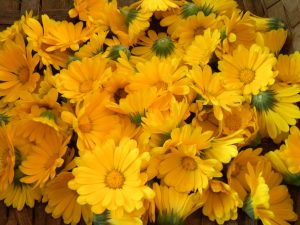
Don’t forget to preserve for medicine as well as food! Calendula can be dried for later salves and balms.

2 Comments

Filed under Chickens, Food Preservation, Gardens, Interdependence, Permaculture principles, Uncategorized

Making Salt: A Winter Yield

Making salt in the winter makes a lot of sense for us, living on the Seacoast and heating with wood. We already try to take advantage of that heated stove top. If nothing else, we put a steamer pot on it to help offset the dry winter air. But, even better is to use it to decrease other energy needs. We cook on it, heat water for tea, dish washing, and some for clothes washing. My daily herbal infusion warms up there. And, now, we’ve learned how to make our own sea salt on it.

Humans gathering salt has a long, fascinating history going back thousands of years that shaped the world we now live in. It’s importance in human health, food preservation and as a trading commodity influenced where cities appeared, the establishment of trade routes, and the outcomes of wars. Did you know that the English suffix “wichoften indicates it was once a source of salt, some of the first roads were associated with the salt trade, and that salt was the focus on Gandhi’s first civil disobedience campaign in India’s struggle for independence from Britain?

Below I will walk you through the process with pictures to best tell the story. First, for answers to common questions we get asked:

Q; Do you get enough salt to make it worth bothering with?

A: Two gallons of salt water create 1 cup of salt. I’m pretty impressed with that!

Q: Aren’t the oceans too polluted now for this to be safe?

A: This is a hard one and I can’t say for sure. But – we have to ingest salt to survive and I don’t know why I’d trust sea salt in the store more than what I make myself. (Most commercial table salts are currently hydraulically mined inland. My research indicates this might not be as bad as other types of mining, but there are consequences.) We have poisoned the whole planet that we are a part of, so it’s not reasonable to think we won’t ourselves be taking some of that in. Maybe if we better connect to how we need the ocean, we’ll be more motivated to keep it clean. Really, when the oceans get so polluted we can’t trust them at all, I think the least of our worries will be can we make salt from them. We forget how critical oceans are to maintaining life on the planet. So… you will have to decide for yourself, and it might depend on what beach you have access to if you think it is safe or not.

Q: What if I don’t have a wood stove?

A: You can use an electric or gas stove to make salt, it just means you are adding that extra energy. Also, solar salt evaporation is worth exploring. Solar dehydrating of food is tough in our climate since microorganisms usually become established before the food dries enough. However, salt is not perishable that way, so it can take much longer to be finished with not worry about it spoiling.

Q: Does it have a different taste or color or texture?

A: I find it to be a little saltier and more complex than what I’ve bought at the store. I read that sea salt shouldn’t be very white… but mine does turn out that way. My method makes a coarse end product. It can be put in a food processor for further refining.

Q: Is it healthier?

A: Sea salt is less processed than rock salts, allowing trace minerals to remain and not introducing additives, which I think is positive. But, both are still mostly sodium chloride, which is critical to have in appropriate amounts – not too little or too much – for good health.  Also, note that your own salt won’t have added iodine so be sure to find other ways to get iodine into your diet, such as seaweed or dairy products.

The Process

The start – and maybe hardest part – of the process begins with gathering the sea water. We recommend it not be completely low tide (unfortunately, since that’s best for getting seaweed!), wear your tallest waterproof boots, and have smaller containers that you can fill and bring to a larger container in your car. You don’t need to worry too much about sand and seaweed bits in the water – you’ll be straining it later. A tight lid for the ride home is helpful.

Once I get it home, here’s what I do…
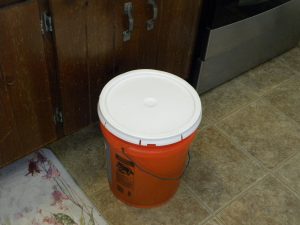
A five gallon bucket, filled to nearly the top, in the kitchen
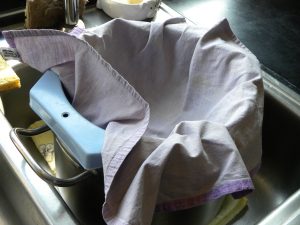
Straining through a tightly woven piece of cloth will catch sand, seaweed, etc.
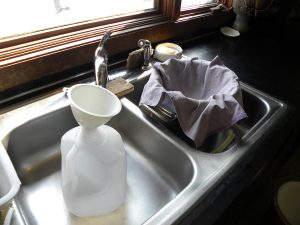
Set up in the sink – pot to strain it into, jug to transfer it to.
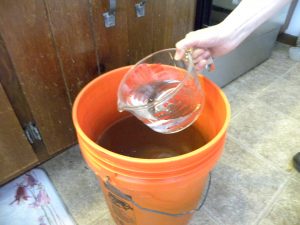
Take sea water from the bucket…
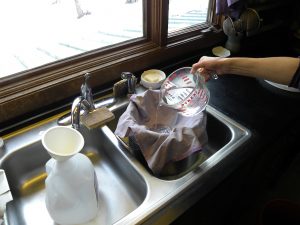
… and pour the sea water into the strainer.
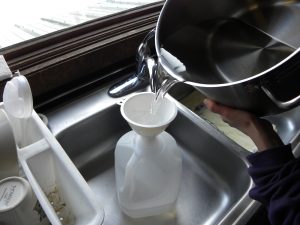
Pour the strained sea water into a non-metal container. Sea water will corrode metal quickly.
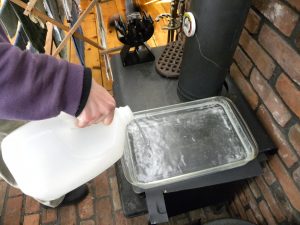
I put aside 2 gallon jugs and pour in what fits into the glass pan sitting on a trivet on wood stove. Top it off as the water level goes down.
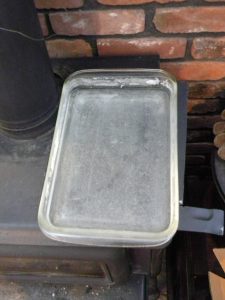
Close to the end of 2 gallons, the water begins to look cloudy.
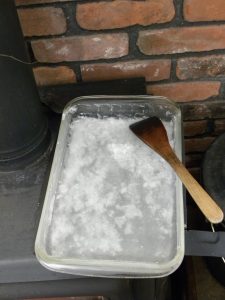
Salt starts to form!
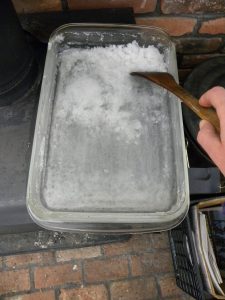
I find pushing the solids to the side facilitates continued drying. My original metal spatula for this showed signs of corrosion after just a few batches.
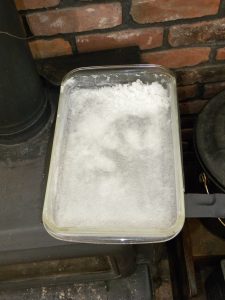
It’s getting close! Note that we don’t have this pan directly on the stove, but on a large, low trivet that Steve created from an old computer case side.
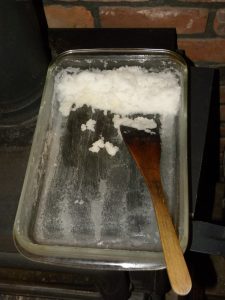
Pushing it to the slightly higher side lets it dry a lot. Then, letting it sit near but not on the stove in an open container for another day lets it really dry out.
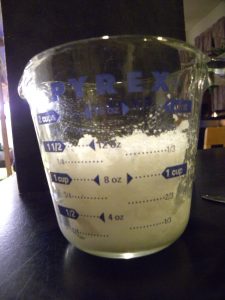
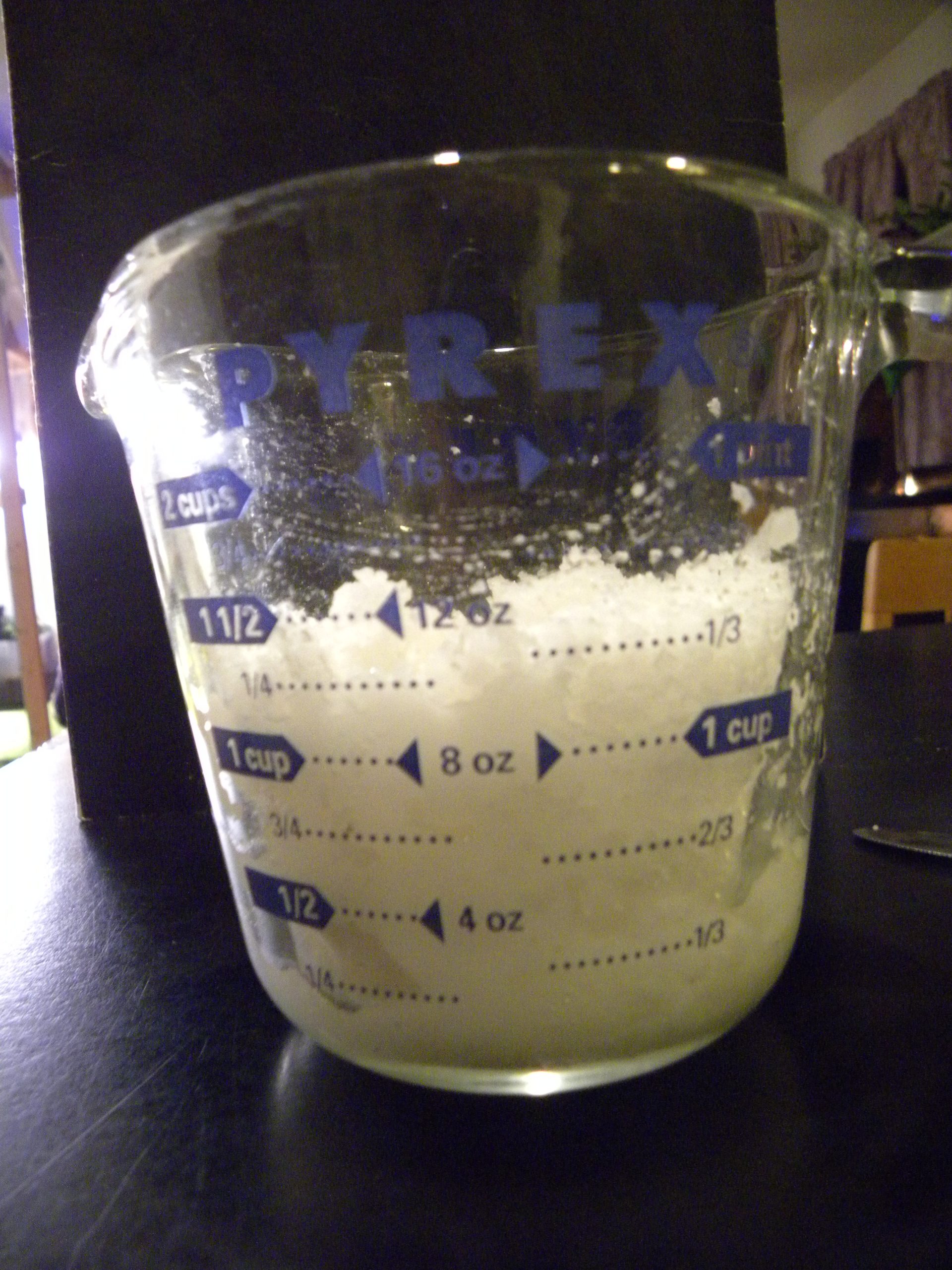
From the 2 gallon jugs, more than a cup of salt.

Store the salt in a tight container to keep it from absorbing moisture. Since you aren’t adding an anti-caking agent, it will be prone to do so and to clump. If that does happen, you can re-dry it near a wood stove or in an oven. It doesn’t go bad, just gets hard to deal with!
Leave a Comment

Filed under Food Preservation, Interdependence, Uncategorized