Tag Archives: goats

2025 On the Homestead

As the year comes to a close, I circle back to permaculture principle 1, Observe and Interact, with special attention to principle 3, Obtain a Yield. I’ll start with reflections, then share our harvest numbers.

Every year I try to come up with a title that captures something unique about the season. That has not worked as well as I hoped because events that were strange are becoming all too normal, like droughts. However, we did just have an event I sure hope won’t repeat often, which leads me to call this the Year of the Hailstorm.
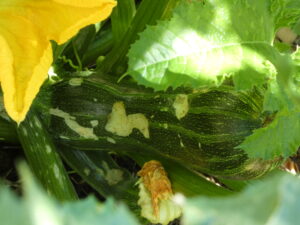
Hail-damaged Zucchini

Weather

While the spring began with lots of rain, it didn’t last, and we lapsed into another record breaking drought year. In fact, it was the driest summer in the 131-years of keeping records for NH, according to NOAA. It was also slow to warm up, with many crops just taking off when the rain stopped falling. That was a challenge, but we were doing well with our water saving and reuse measures.

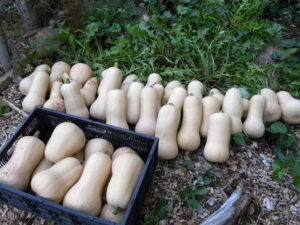
Then, on August 27, we were hit with a short but intense hail storm. I have never seen anything like it. Sheets of ice pouring down, bouncing around, covering everything, and shredding plant leaves and damaging fruit as it fell. It left an inch of ice on the ground covered by shredded leaves. The big, fragile leaves of the squash were ripped apart, and the developing fruit ended up covered in cuts. That was a huge loss for us as we usually grow hundreds of pounds of winter squash to feed to the goats and chickens as well as ourselves all winter long. Last year, we brought in 878 pounds – this year we harvested 289 pounds, all of which are too injured to last long.
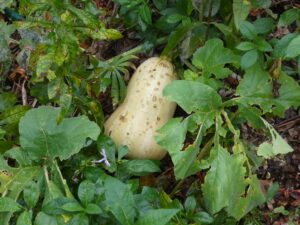
Hail Damaged Squash Plants

The cuts healed over, but these butternuts will not last long


Rodents, Pests and Diseases

In this category, we are happy to have multiple successes to report.

Our new vole-thwarting raised beds and barrels are working well, especially for carrots and beets. We used found materials of imperfect metal roofing and wood pieces to construct four more that are extra tall. We create the soil in them using sheet mulch and hugelkultur techniques – rotting wood, manure, animal bedding, fallen leaves and seaweed, topped by finished compost to plant into. So far, voles have not infiltrated them, and the height makes them much easier to access and care for.

Building Vole-proof Beds
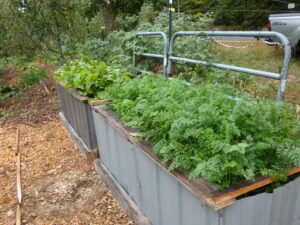
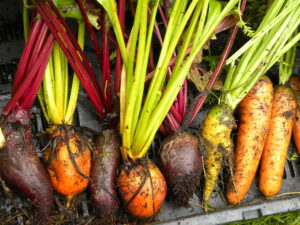
Carrots & Beets Thriving in the Raised Beds


We’ve also been more diligent in covering our brassica crops – kale, collards, broccoli and Brussels sprouts. Without the cabbage loopers (Trichoplusia ni), imported cabbageworms (Pieris rapae), cross-striped cabbageworms (Evergestis rimosalis) and diamondback moths (Plutella xylostella) reaching them, they grew into big, beautiful plants, especially the collards. They did have aphids multiply under the row cover, but aphids don’t do very much damage compared to all those
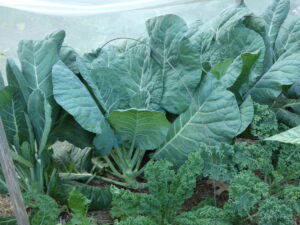
Collards big enough to shade the kale!

caterpillars. The Brussels sprout plants grew tall, but never made sprouts. My research shows there can be many reasons for that outcome, and I suspect the drought was the problem this time. 
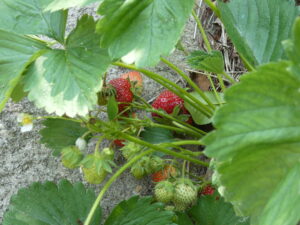
 

This was by far our best strawberry year, on the whim of the chipmunks to let us have them. I had given up on competing with the rodents and was thinking of the carpet of strawberries in parts of the orchard as a ground cover not a food crop. Then, they just gave them to us this year. I mean, they took a few, but usually they eat every one of them before they even turn red. My only guess as to why, is that the wet spring added some water weight to the berries and they were not super sweet. Whatever the reason, we harvested 97 ½ pounds, which I canned into 34 pints of berries and 10 pints of juice. After boiling them down, they were plenty sweet for us!
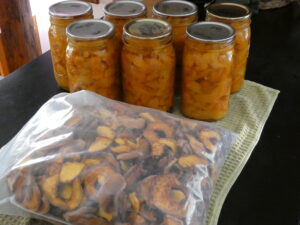
Peaches Preserved

The squirrel population did grow over the season, and some of our late season peaches were gobbled up by them, leaving just pits around the trunk, but we still got our share – 304 pounds. Last year’s harvest was twice that, but 2024 was the Year of the Peaches here and I don’t expect another bumper crop like that anytime soon.

Labor

Having enough time to spend tending the homestead despite our other off-farm demands will always be a challenge. We do feel that we have found a decent balance, not taking on too much in a season that we cannot keep up. We lean into the crops that take less of our time, like winter squash, drying beans, and root crops, and are careful not to overdo the more time-intensive ones, like snap beans and peas.

Animals

Here again the trick has been to learn what the land and our workload can handle for optimal health for us all (Observe and Interact). Over time we have created systems that make management easier, like the wheeled chicken “tractors,” the movable electric netting for rotational goat grazing, and the water catchment stations. The poultry thrived, and we continue to keep the predators out despite knowing we are surrounded by wild critters who would love to eat them.

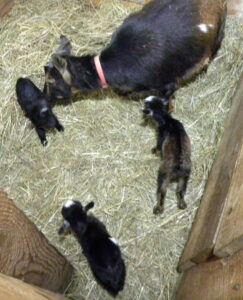
The goats are doing well, although not all went exactly as planned. Georgia had an accidental (in our opinion) pregnancy, and the kidding ended up being a complicated one. We were able to reposition the stuck kid, so it worked out, but it was stressful. We are also having trouble selecting one of Luna’s daughters to join her. Luna has been our best milking goat, but so far her kids have not been living up to her legacy of health, productivity and ease of managing. My ideal is to have four does in milk, two mother-daughter pairs, but we have not been at that level for a couple of years. At our small scale we have to keep the number of goats low, but that makes breeding and selecting a slower process. Hopefully our new doeling, Lucia, who is Luna’s granddaughter, will help get us back on track.
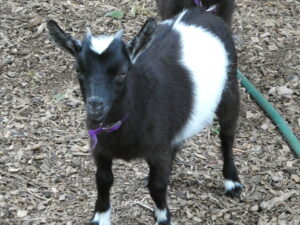
Meet “Living Land Lucia”

This year’s drought has made getting enough good quality hay difficult. We did bring quite a bit of nice extra forage home for them, between Steve’s landscaping work and fall apple gleaning around the Seacoast.
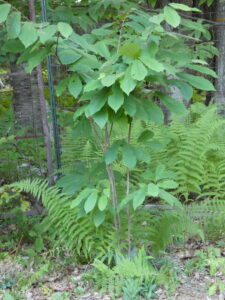
Paw Paw Tree

Also…

One of our paw paw trees is finally taking off!  After failing to get them established for years, we seem to have figured it out.  Early planting of very small trees, giving them shade the first two years, and being very patient is what seems to have worked for us.  There is a second variety nearby, which is a little younger and still very small – but alive, so we are hopeful.

We continue to succeed at growing all our own seedlings to start the garden. It is another great yield for us.  We’re happy to get to start them out with more sustainable materials, organic methods, little transport stress, and we have no risk of bringing back diseases or pests, like cutworm.
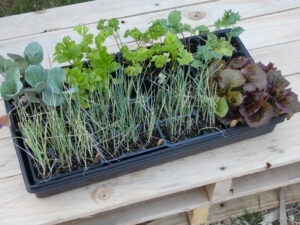
Our Own Seedlings

2025 Harvest Numbers

Alliums – garlic – 17.5# (130 heads); 130 garlic tops – ; leeks – 61#, perennial onions – 8.5#

Beans & Peas – snap beans – 52.75#; dry beans – 10.25#; sugar snap peas – 6.25#

Brassicas – broccoli – 4.25#; brussels sprouts – 1.75#; kale – 8.75#; collard – 20.5#

Corn, popcorn – 7#
Cucumber – 11#

Eggplant – 0#

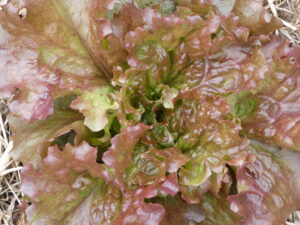
Lettuce – 13.75#

Herbs – basil – 4.25#; dill – .5#

Mushrooms, winecap.5#

Potatoes – 31.5#

Roots – beets – 25#; carrots – 56.75#; parsnips – 53.25#; radishes – 204, turnips (gold ball) – 1#; dandelion roots – 30.5#

Squash – summer – 69.25#; winter (butternut and long pie pumpkin) – 289#

Tomato – slicing – 39.5#; cherry – 11.5#

Perennial Veggies: asparagus – 1.5#; rhubarb – 23.5#

Hazelnuts – 1.5#

Fruit: blueberry – 7.5#; crabapples – 30#; currants, red & white – 4.5#; clove currants – 6#; goumi – 7.5#; grapes – 3#; honeyberry – 9#; jostaberry – 2#; mulberry – 3#; peaches – 304#; raspberry – 1#; strawberry – 97.5#

Honeyberries

Maple syrup – 5 pints

Sea salt – 1.25 gallon

We brought in 58 gallons of goat milk; 114# goat meat; .5# goat lard

Our poultry harvest came to: 1,487 (124 dozen) chicken eggs from 10 hens; 492 (41 dozen) duck eggs from 5 ducks; chicken meat – 76#

Gleaned crops: apples – 550#

Food Preserving

Preserving food is how we eat from our farm year-round. Here’s a summary of what I put up this year:

Canned: peaches – 28 quarts; strawberries – 34 pints; honeyberries – 9 pints; clove currants – 7 pints; grape juice – 1 pint; strawberry juice – 10 pints; goumi jelly – 6 ½ pints; currant jelly – 3 ½ pints

Dried: peaches – 10#

Refrigerated: lactofermented cucumber pickles – 6 quarts

Frozen: blueberries – 1 gallon bag; snap beans – 8 pts; basil pesto – 11 ¾ pints; chevre cheese – 20 pints; mozzarella cheese – 12#; and most of the meat.

Root cellared: carrots, beets, parsnips, dandelion roots.

We store these crops in a cold room: garlic, potatoes, winter squash, and apples.

These are stored on the shelf: dried beans, popcorn.

Other yields we enjoyed included: wood for heating, water captured for the garden and animals, medicinal herbs, exercise, clean air and beauty.

In looking it over now, we can see that our particularly successful crops this year were strawberries, snap beans, collards, leeks, parsnips, radishes, zucchini, carrots and parsnips.

We had disappointing yields from our winter squash, Brussels sprouts, eggplant, grapes and pears.

Looking Ahead

Fall projects freed up more discarded metal roofing so we will make more raised beds to get our root crops back to thriving, able to fill the root cellar again.

Our fall Fedco tree order will bring us Asian pears to plant in the spring. They are not as tasty as European pears, but they mature faster. I love pears and am getting impatient with the many trees we’ve put in here that have yet to produce any fruit for us.

After taking a fall workshop in the forestry practices of coppice and pollard management, Steve is excited to improve our forage potential on site through better silvopasture systems. That will include experimenting with hedge-laying, which he has winter reading lined up to prep for. 

Thank you all for reading, even to the end of this post!  We hope this next year is a productive one for us all, individually and collectively.  There is a lot of often messy work to do – may it bear beautiful fruit.

Goumiberries
4 Comments

Filed under Chickens, Food Preservation, Gardens, Goats, Permaculture principles, Poultry, Uncategorized, Weather

My Favorite Part of Winter

The more I have adopted an agricultural lifestyle the more I have learned to embrace winter. While I am still not happy with the cold or the lack of lush, green surroundings, the break from the hard outdoor work is appreciated. I am tired by the end of the growing season. Plus, there is other work in the world that is important to me and the winter gives me time to focus on that.

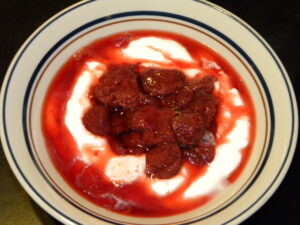
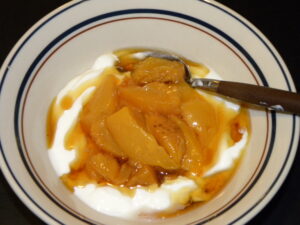
Yogurt With Our Peaches

But, if I had to narrow it down to my top favorite aspect of winter I think it would be this: yogurt.

When you produce your own food, you learn the nuances and variations that are lost in a standardized, commodified industrial system. From year to year and season to season differences in the weather and other conditions impact taste, texture, and production. This is particularly true for milk. To some extent what we feed our goats actually changes the taste of the milk, but, more obviously, the seasons greatly change the texture. In the summer when the sun is high and the fresh green plants are abundant our goats give us much more milk. It is delicious but not very thick. The amount of milk they produce in the winter is much less, but the fat percentage is significantly higher thus it is sweeter and more nutrient rich.  It also makes extremely thick and creamy yogurt. The winter goat yogurt that I make might be my favorite food in the world.

Yogurt with Strawberries

Years ago, actually decades by now, I was a vegetarian and then vegan for environmental and ethical reasons. I did OK for a few years as a vegetarian but when I cut out eggs and dairy some serious problems developed. I love beans so was getting plenty of protein but I could not get enough fat or B12 to stay healthy. After about six months, I stopped being able to eat at all. Everything I tried made me incredibly nauseous. Then, my roommate ordered a pizza. It wasn’t particularly good pizza, but the smell was heaven and for about a week it was almost all I could eat.

I did not take the hint from my body, however, and went back to being vegan. I again lasted about six months before things started to unravel again. At that point I had to admit that this was not working for me, and move through my disappointment and a small existential crisis to re-embrace animal products. I could have chosen to take pills, but I decided that supporting the pharmaceutical industry was worse than supporting my local farmers. After about a week of putting butter and cheese back on my plate I felt so much better I knew I would never give them up again. Given that my ancestry is from the dairy producing area of Ireland and various goat-keeping places in the Mediterranean I guess it makes sense that this works for my body.

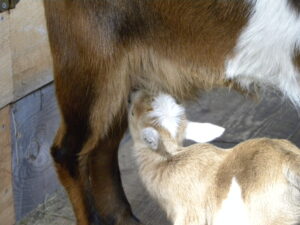
Goat Kid Nursing

And, yogurt cultured from raw milk created in my backyard from the animals I know and love really does sound like a perfect food. Topped with fruit I canned from the previous summer and either honey or maple syrup from the neighborhood… what food could be better for me or the planet?

Nourishing, delicious food is something I am grateful for every day, especially when I remember that there are people in the world who don’t have anything to eat at all.

I eat my yogurt year round, but it is at its best December through March and that is a bright spot in an otherwise dark time of year, one that I will miss as we head into Spring.

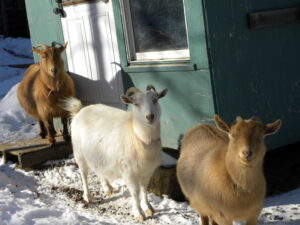
Our Goats in Winter: Georgia, Lily & Honey

2 Comments

Filed under Food Preservation, Goats, Uncategorized

2023 on the Homestead

Back in August I posted with an update on our season up until then. Now that 2023 is over I can give you a review of our full season as I take time in this quieter time of year to reflect.

A Great Butternut Year

I was moved to post about our season in August because of the challenges. I have written many summaries that cite drought as a limiting factor but this is the first one I’ve done where excessive rain is what caused us problems. That issue continued for the rest of the year. However, some of our fall crops were better than expected so our season did pick up towards the end.

To be consistent over time, I have kept most of the same topic headings as in previous years.

Weather & Water

This summer was the wettest on record for New Hampshire with 21 inches of rain recorded for June, July and August, 8 inches more than the average.

Given the recent droughts it’s hard to be annoyed by rain, but it definitely turned out there was such a thing as too much. We did not experience direct damage in our systems, like erosion, but the wet conditions still caused problems, the biggest one being plant diseases appearing and spreading more than usual.

Our water catchment systems came in handy in a different way than intended. Some of the storms had torrential rain that could have washed out paths and other areas. By emptying the storage totes in between storms we could keep the water in place and slowly drain it over a longer time period.

Our biggest crop loss actually had to do with the winter weather. The polar vortex in February destroyed our – and New England’s – entire peach crop. That was a big loss for us, as long-time readers will know I do a lot with peaches!

Rodents, Pests and Diseases

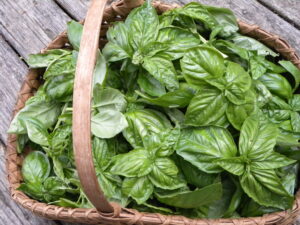
Basil – surprisingly undaunted by the wet conditions this year

As I mentioned, we did have more disease issues than usual this year. There was some sort of bacterial wilt that shortened the lifespan of a few of our crops: peas, cucumbers, and summer squash.

This year we took further measures to protect our plants from animals, especially porcupines and voles. First, for the porcupines, we added another run of fencing that includes a gate across the driveway that we close at night. It did not work at first because it turns out the porcupines can climb fences like a ladder. But with the addition of one string of electric along the top, we finally convinced them that our pear trees were not worth coming after. This also keeps out the deer, which weren’t a huge problem but sometimes did come through and nibble.

Vole Protected Root Crops

To deal with the voles we have started making garden beds that sit on metal mesh hardware cloth and have wooden sides. This uses more materials than my usual mound garden beds, but it is working. So, for the carrots and beets we plan to make more of these beds. We planted our potatoes in big plastic barrels cut in half. It did keep out the voles, but yields were very low. I had been worried about them drying out so positioned them in a somewhat shady area which was a mistake in such cloudy, wet weather. I also think they weren’t draining well enough since in a few of them the tubers just rotted. We’ll try again next year.

Gorgeous Spring Kale, Before the Caterpillars

The past two years we have had big outbreaks of caterpillars eating our brassicas. While I have always dealt with imported cabbageworm and cabbage looper, we suddenly have an overwhelming number of what I believe are cross-striped cabbageworms. These used to only be a problem in the South, but they have been making their way north with the changing climate. We are finding them far more destructive than other Brassica pests. Since we do not use any chemicals, we will look into barrier methods such as growing in hoop houses or under row cover.

Labor

The one upside to less productivity this year, was less physical work to do. Given that my arm injury was at its worst this year, it would have been a struggle to cut peaches for canning or keep up with much bigger yields.

It did give me more time to invest in some other important work in the world. We hosted more Seacoast Permaculture gatherings and classes and I became chair of the board for New Hampshire Peace Action which has been going through a transition in leadership, thus needing more volunteer help. To a large extent I came to farming and homesteading through being an activist, particularly a peace activist, in the tradition of The Nearings and others. So, to me, this is connected and complementary work anyway.

Animals: Bees

I continue to take a break from beekeeping while I try to heal my arm injury.

Diana and her triplets!

Animals: Goats & Pasture

Luna and her daughter, Diana, were this year’s mama goats.

The birthings went well, I’m relieved to say. However, Diana gave birth to triplets (which is a lot for a first time) and did not take to motherhood easily. There was about an hour when we thought she might entirely reject her kids – heartbreaking. But, we gave her support and coaching and she finally figured it out. That said, she was not an enthusiastic mother and did not give a lot of milk, so she will not be incorporated into the herd permanently. Luna, who is our star goat, had twin girls this year, and we will keep both of them. Hopefully at least one will be as great as their mom – healthy, vigorous, easy kidder, attentive mother and good milk producer. Making decisions like this is not easy for us, but we see careful breeding as our duty to the herd. (Note that

Luna with her kids, Maeve and Fionnuala, 5 months old

if you are buying goats or other working animals, I highly encourage you to buy from people who do cull and eat their animals, otherwise you are likely being sold their rejected stock.)


We are increasingly skilled at rotating the herd through our pastures, and the land is responding beautifully. Lots of lush green, very little bare ground, soil further coming to life and building up organic matter, carbon and nutrients. The positive power of well-managed grazing animals to improve land is amazing to witness!

Goats on Good Pasture

Our two new boy goats, Zac and Ike, who arrived Fall 2022 settled in well and Zac proved his ability to do his job – Diana’s triplets were his kids.  Ike is the polled (born without horns) whethered (neutered) companion for Zac.  I worried that an unhorned male would get pushed around a lot by our big horned boys, but he has tons of attitude and less threatening hormones so he appears to get his way more than anyone else!


Animals: Poultry

New Ducks

We incubated a couple rounds of chickens to raise for new young hens and meat. In the spring our two youngest female ducks disappeared, likely taken by aerial predators. A friend of ours who has good luck hatching ducklings helped us out with two rounds resulting in seven ducks. Only two were female but, well, better than none! Also our drake happened to die over the summer so we were able to replace him.

Grains

Despite last year’s promising test plots, our wheat failed this year. The fall planted crop didn’t overwinter well, and my attempts at spring planting may have been too late, or maybe birds and rodents ate the seed before I got there.

Red Sails Lettuce

Harvest totals 2023

Here is what we brought into the house and remembered to weigh. As you’ll see, some things had decreased yields, notably the cucumbers, summer squash, potatoes, kale & collards. There are a few things that I purposely planted less of, so if you compare years you would notice a decrease.  These were intentional to better match what we need: garlic, radishes, snap beans. Our root numbers, especially beets and carrots are still low but should be recovering as we change our practices. At least this time I did not plant 10 times as much seed to get about the same number of carrots and beets.

On the other hand, check out our winter squash numbers! Also, dry beans and popcorn did extra well. Our small fruits had generally strong yields, too.

Alliums – garlic – 25.5 pounds (#) (155 heads); 150 garlic tops; leeks – 42.25#, perennial onions – 9.25#

Beans & Peas – snap beans – 50.75#; dry beans – 23.5#; sugar snap peas – 3.75#

Brassicas – broccoli – 8#; brussels sprouts – 9#; kale/collard – 12#

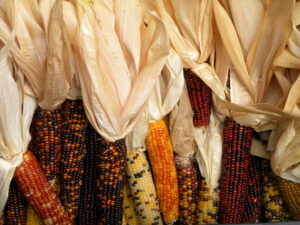
Calico Popcorn still on ears

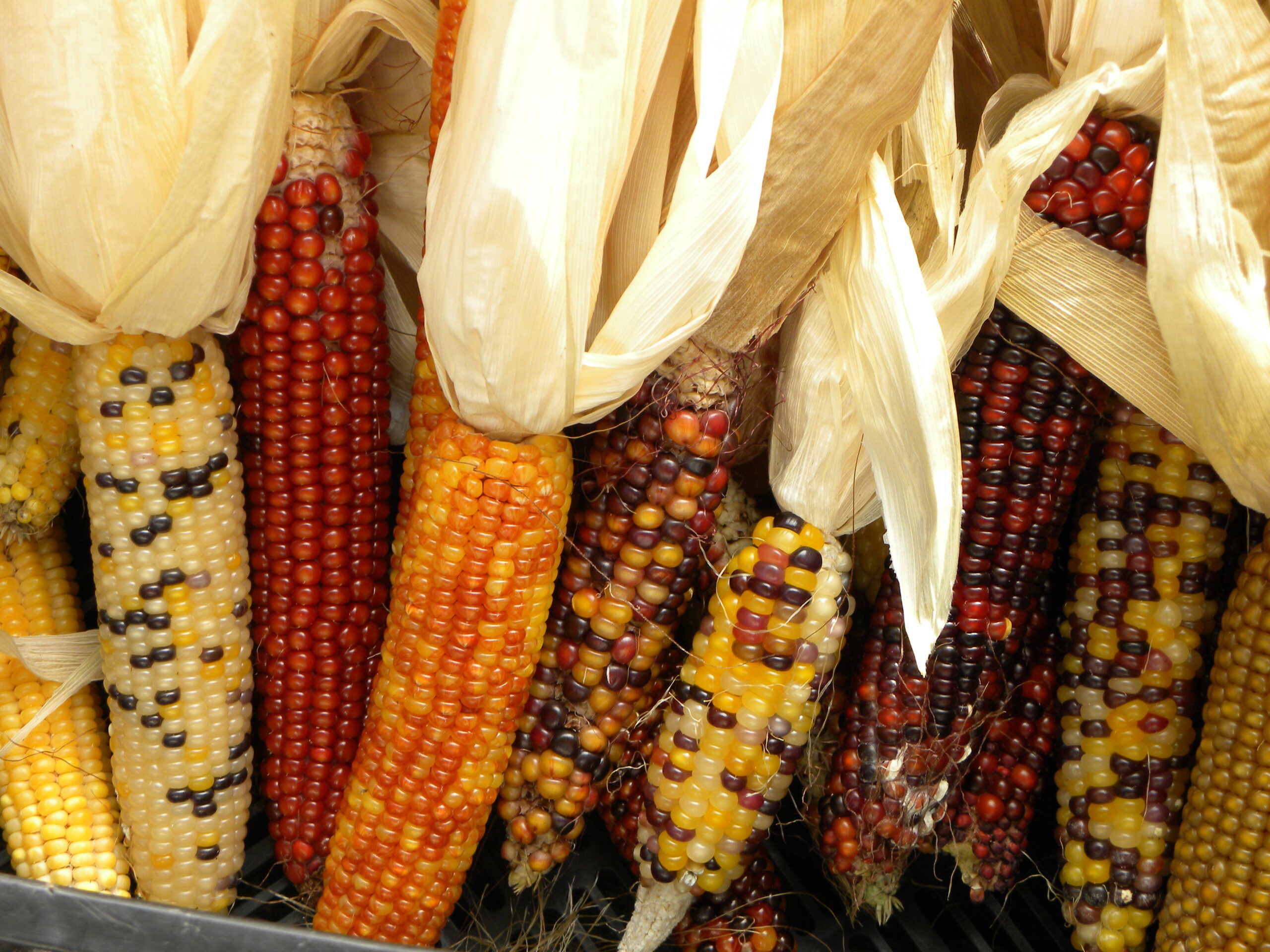
Corn, popcorn – 10.5#

Cucumber – 39.5#

Eggplant – 14#

Melons – 7.5#

Greens – lettuce – 8.25#; nettles – 2#

Herbs – basil – 5#; dill – 1#

Mushrooms, winecap – 2#

Potatoes – 16.5#

Roots – beets – 11.75#; carrots – 30.75#; parsnips – 28.5#; radishes

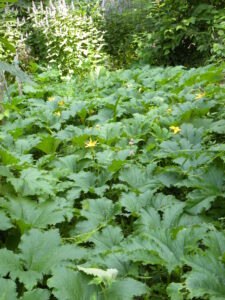
Winter Squash Vines

– 58; turnips (gold ball) – 13.5#

Squash – summer – 25.25#; winter (butternut, long pie and Seminole) – 939.5#

Tomato – slicing – 29.75#; plum – 14.5#; cherry – 27#

Wheat – crop failed!

Fruit: azarole – 1#; blueberry – 6#; crabapples – 39.5#; currants, red & white – 2.5#; clove currants – 18.5#; elderberry – 3#; grapes – 13.5#; honeyberry – 2.25#; jostaberry – 5.5#; mulberry – 2.25#; raspberry – 2#; rhubarb – 17.5#

Maple syrup – 2.5 gallons

Sea salt – 1 gallon

We brought in 91 gallons of goat milk (from 4 goats); 28.5# goat meat; 3# goat lard

Our poultry harvest came to: 1,571 (130.9 dozen) chicken eggs from 12 hens; 480 (40 dozen) duck eggs from 3 ducks; chicken meat – 56#; duck meat – 6#

Gleaned/gathered off-farm crops: apples – 800#; blueberries we picked from Tuckaway Farm – 49#

Food Preserving

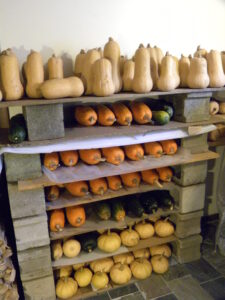
One of our Winter Squash Storage Shelves

Preserving food for the off-season is how we eat from our land year-round. Here’s a summary of what I put up from the harvest I just detailed:

Canned: applesauce – 20 pints; blueberries – 40 pints

Dried: kale/collards – 3 gallon bags; grapes (raisins) – 2 pts

Refrigerated: lactofermented cucumber pickles – 9 quarts

Frozen: blueberries – 2 gallon bags; grapes – 4 gallons; various berries – 6 gallons; snap beans – 12 pts; eggplant – 4 qts; summer squash – 6 qts; basil/garlic pesto – 13 pints; chevre cheese – 10 pints; mozzarella cheese – 12#; and most of the meat.

We also store these crops in a cold room or on the shelf: dried beans, popcorn, garlic, potatoes, carrots, beets, parsnips, turnips, winter squash, and apples.

Looking Ahead

My homestead plans for the coming year are to continue to refine our current systems to be more effective, easy to use, and in some cases more productive. A lot of the infrastructure work has been done here. I wouldn’t say this is our “lie in a hammock” time, but I do expect that we will continue to shift to even more harvesting with less big project work. That is the goal of permaculture… there is a lot of work up front to create the systems, and they will always need some attention, but the workload should not be as intense as we go along.

I’m going to try again with grain growing this year. And with any luck, I will have lots of peaches to can this time around!

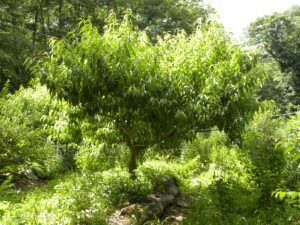
Gorgeous Peach Tree… Hoping for Fruit in 2024

2 Comments

Filed under Chickens, Ducks, Food Preservation, Gardens, Goats, Uncategorized, Weather