This past November, Steve attended a workshop on agroforestry practices at Wellspring Forest Farm in New York led by Mark Krawczyk & Steve Gabriel. Steve has been experimenting with these techniques for years. This workshop, along with the books both the leaders have written, has deepened his understanding of the systems so he can make even better use of them. Here are his reflections, which tie in multiple permaculture principles:
Berries from perennial plants are abundant in these systems
For more than ten thousand years, our ancestors lived in extraordinary symbiosis with woody plants. Fossil fuels did not yet make unsustainable and polluting mass production possible. Humanity’s regular harvest of young wood encouraged tree species that sprout back reliably and renew the vigor of a tree’s eternal youth. Cord wood illustrates this difference. A mature forest in NH might sustainably produce 1 cord per acre per year. When managed as an established coppice stand cut to the ground every 3-5 years, each acre can consistently produce 5-10 cords per year! In the case of oak, fast-growing coppice wood is actually denser than old growth wood, thus more useful as fuel in less space.

Edible mushrooms can thrive in the shade of coppice and pollards
But heat for warmth and cooking were just the beginning of how people met their needs with wood, often from the same land that served numerous other purposes. Such function-stacking embodies the principles of permaculture, including catch and store energy (#2), obtain a yield (#3), use and value renewable resources and services (#5), produce no waste (#6), integrate rather than segregate (#8), Use small slow solutions (#9), use and value diversity (#10), and use edges and value the marginal (#11). We are just beginning to rediscover the depth and nuance of what is possible and was, until recently, understood by every human who has lived in a wattle and thatch cottage since the last ice age.
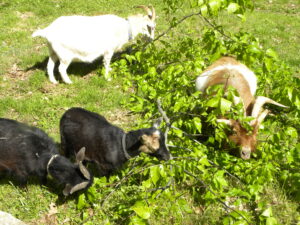
Woody plants are excellent goat food (fodder)
Intensely managed coppice, pollard, hedge and wood pasture lands provided food, livestock fodder, tools, various supplies for crafts and cottage industry, building materials, rich hunting grounds, transportation infrastructure, fencing, fishing weirs, musical instruments, and most everything else people needed. Indeed there were hardly any other options available for securing needed resources, especially as the population of people increased. It was common knowledge how to use a “froe” to make “hurdles”, how to lay “pleachers” and bind “heatherings”, how to “handle” an axe (literally), how to cut “chips” with hand tools, and how to carve wood with an adze, draw knife, hewing axe and other tools that are now all but forgotten. Such carving was critical to building strong ships that could reliably cross oceans. The extensive jargon people used to describe these practices and tools demonstrate its importance as the center of economic productivity. With time and evolving specialized expertise, wood was also the basis of charcoal production which fueled the refining of iron ore into the fundamental tools of early civilization.
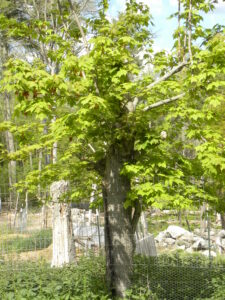
A Pollarded Maple
If you can picture a world before chainsaws, skidders, trucks, and portable sawmills for cheap dimensional lumber, it becomes clear that smaller diameter wood is safer and easier to process with basic hand tools. Even with modern options, this reality is still true. Most common species of temperate trees – except evergreens – sprout back well if a clearing large enough to provide abundant sunlight is made and the stump is protected from excessive impact by herbivores. Coppicing involves cutting to the ground every 3-20 years, producing fairly straight rods and poles. Pollarding maintains a tree small enough for easy management yet keeps most of the foliage out of reach of herbivores, by cutting the central leader at 6-10 ft. Laid hedges are tightly planted rows of vigorous shrubs (such as willow, hazel or hawthorn) cut partway through and laid down to encourage low growth, with horizontal pieces woven between vertical stakes to form a tight living fence. Dead brush can similarly be woven between stakes to form a dead hedge fence where light is less abundant.
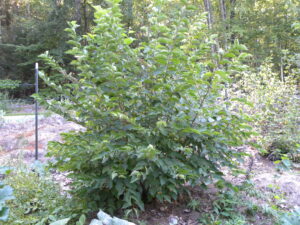
Hazelnuts are a great hedge shrub
In this way abundant animal fodder, posts, poles, rods, stakes, fencing, basket-making twigs and various other useful supplies can be produced quickly on a few sunny acres. At the very least, keeping a few trees alive and forever young moderates temperature extremes and builds soil fertility from the leaves they drop. Consider these factors if you seek to build greater sustainability and self-reliance on your homestead, in your community and throughout our troubled world.
For more information on this topic consider attending my upcoming online class and in-person tour through Seacoast Permaculture.
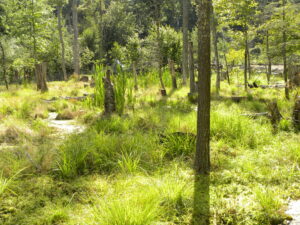
One version of a silvopasture system